
How To Style Your Bookself
Interior Design Tips with Rooted's co-owner Ashley
It may go without saying, but the perfect bookshelf starts with books. They’re the foundation, the heart of it all. But a shelf lined edge-to-edge with books of the same height and thickness can start to feel a little repetitive. When everything creates one long horizontal line, the eye doesn’t have much to explore.
The first step to creating a more dynamic, lived-in bookshelf is variety. Ashley loves pairing books with vibrant colors while also mixing up their height and thickness. A few tall hardcovers next to slimmer paperbacks immediately break up that monotony. Think of it as giving your shelf a rhythm instead of a straight line.

Mixed Orientation Is Your Friend
Ashley likes to think about how your eye takes in the bookshelf as a whole — not just one shelf at a time. If every shelf has its heaviest grouping of books on the left, the entire piece can start to feel lopsided. Instead, vary where those visual “weight” moments happen. Maybe one shelf is book-heavy on the right, the next is centered, and another leans left. This creates overall balance and keeps your eye moving comfortably up and down the entire bookcase.
Mixed orientation is staggering your books instead of lining every book up vertically from end to end. Try centering a group in the middle of the shelf and leaving breathing room on either side. Or stack a few horizontally to create a little pedestal for something special.
Those sideways stacks are incredibly useful. They add height exactly where you need it and give you a surface to place a small object on top. It’s practical and visually interesting at the same time.

The Rule of Three
Designers often talk about the “rule of three,” and Ashley finds herself coming back to it again and again. Three distinct objects with varied height and shape naturally create visual interest.
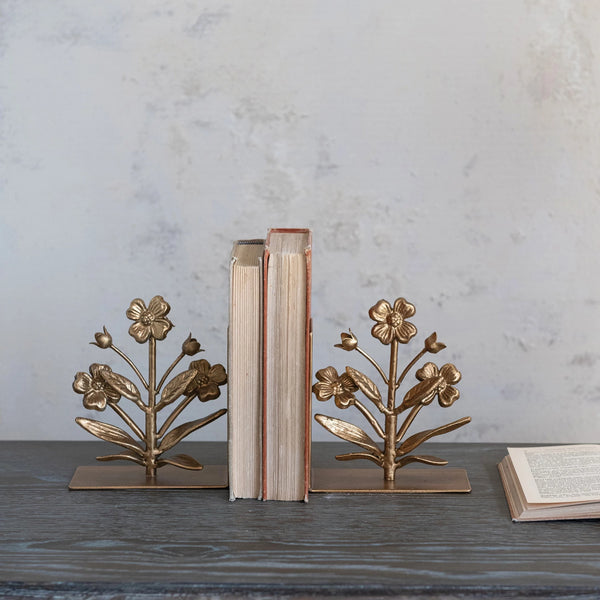
On one of her shelves, she has a taller stack of books flanked by shorter matching bookends. The symmetry of the bookends brings balance, while the height difference keeps it from feeling flat. On another shelf, balance shows up differently — a larger object anchors one side while a smaller piece offsets it on the other. It doesn’t have to be perfectly symmetrical, but it should feel intentional.
Add Dimension Beyond Books
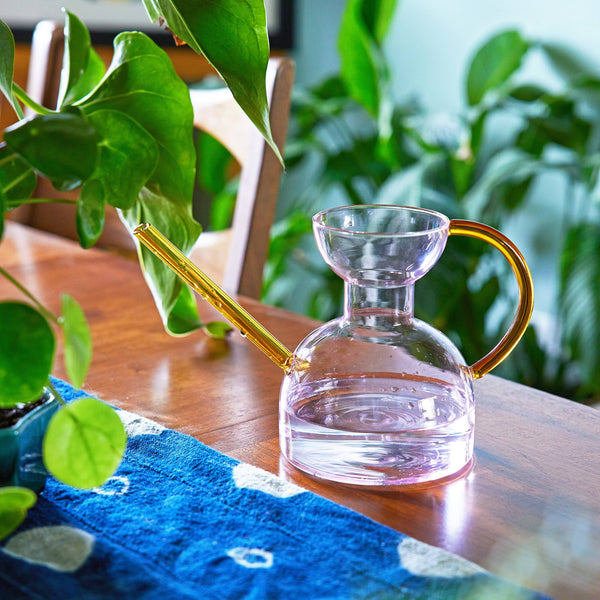
Books provide a lovely texture, but layering in other materials adds depth and personality. Ashely incorporates brass and glass pieces for contrast. A small sculptural object, a vintage trinket, or a meaningful keepsake can completely change the mood of a shelf.
Perhaps the most transformative thing you can do for your bookshelf is to add plants. Preferably real ones. A trailing plant softens the hard horizontal lines of the shelves and brings movement to the space. You can also create dimension by layering — place a tall, flat item like a framed photo or small mirror toward the back of the shelf, then position a leafy plant slightly in front and off to the side. Paired with a stack of books, it becomes a lovely little vignette.

Make It Personal
Most importantly, have fun with it. Your bookshelf should feel like you. Add pieces that hold memories, little doodads you picked up on a trip, something handmade, something inherited. It doesn’t all need to match perfectly. In fact, it shouldn’t.
That’s where the charm lives, in the mix. A home feels special when it reflects the person who lives there, not when it looks like it was lifted straight out of a catalog. Style your shelf in a way that tells your story.